



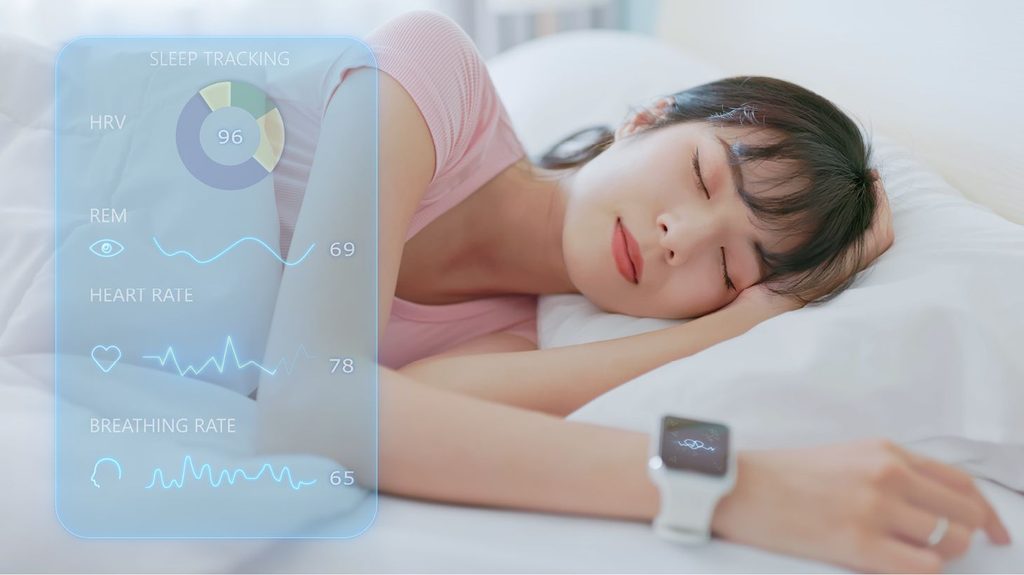
Sleep is one of the most powerful predictors of long-term health. Chronic lack of sleep has been linked to hypertension, cardiovascular disease, diabetes, obesity, impaired immune function, depression, and cognitive decline. In lifestyle medicine, improving sleep is often one of the highest-yield interventions for optimizing overall health.
At the same time, we are seeing a rapid rise in wearable health technology. Devices such as the Oura Ring, Apple Watch, Fitbit, and WHOOP now provide continuous insight into sleep patterns that were previously not available in the everyday setting. This raises an important question: how useful and how accurate are these tools?
What Sleep Trackers Actually Measure
Modern wearables continuously collect physiologic data using optical sensors, motion detectors, and temperature sensors. These signals are analyzed using machine learning (AI) algorithms to estimate:
• Sleep timing and duration
• Sleep stages (light, deep, REM)
• Resting heart rate (RHR)
• Heart rate variability (HRV)
• Respiratory rate
• Skin temperature
• Recovery and stress trends
Importantly, these are indirect estimates.
What Wearables Do Well
Among available devices, several — including the Oura Ring — have shown strong performance in measuring resting heart rate, often within a few beats per minute compared to electrocardiography under resting conditions. Heart rate variability, a marker of autonomic nervous system balance and physiologic stress, is also reasonably reliable when evaluated as a trend over time (whole night or consecutive nights), rather than as a single data point. [1]
Temperature tracking is another area of strength. Continuous measurement allows detection of subtle physiologic shifts, including early illness signals or ovulation patterns, which are difficult to capture otherwise. Oura for example outperforms calendar-method for ovulation tracking, being able to identify approximately 96% of ovulations. [2]
Where Sleep Tracking Becomes Less Precise
Tracking sleep is more complex than tracking heart rate. The gold standard for sleep assessment is polysomnography, an overnight study that measures brain activity, eye movements, muscle tone, airflow, oxygen levels, and heart rhythm.
Because wearable devices cannot measure brain activity, they estimate sleep indirectly using signals such as movement and heart rate patterns. As a result:
- Total sleep time is generally estimated within about 30 minutes
- Devices tend to overestimate sleep by counting quiet wakefulness as sleep
- Sleep stage classification is only moderately accurate
Current data suggest sleep stage agreement with polysomnography is approximately 60–70%, meaning sleep stages identified by wearables should be viewed as approximations rather than precise measurements.
What Wearables Cannot Do
Wearable devices are not FDA approved sleep disorder diagnostic tools.
They can identify patterns — such as fragmented sleep or reduced sleep duration — but they cannot diagnose sleep disorders. This limitation is particularly important in conditions like obstructive sleep apnea, where wearable devices have limited sensitivity, especially in detecting mild sleep apnea.
Symptoms that should prompt formal evaluation include:
- Loud habitual snoring
- Witnessed apneas (not breathing)
- Excessive daytime sleepiness
- Morning headaches
- Poor concentration or memory
- Resistant hypertension
In these situations, formal testing — either polysomnography or home sleep apnea testing — remains the standard of care. [3,4]
Choosing the Right Device
There is no single “best” device. The most useful device is the one that is worn consistently, and selection should be based on individual goals — whether that is sleep optimization, cardiovascular monitoring, or athletic performance.
Oura Ring: strong for sleep trends, HRV, and temperature tracking, cost range varies depending on a model, and users pay small monthly subscription.
Apple Watch: broader health monitoring, including limited electrocardiogram (ECG) and oxygen saturation. For sleep specifically, Apple Watch showed lower agreement with PSG than WHOOP. However, Apple Watch demonstrated stronger agreement for heart rate and oxygen saturation. Not FDA approved for sleep tracking, but FDA approved for ECG and arrhythmia detection. Its higher cost reflects its role as a full smartwatch. No monthly subscription needed.
Fitbit: user-friendly. High sensitivity for detecting sleep, though it tends to overestimate total sleep time. Price is more affordable and accessible, and it has an optional monthly subscription.
WHOOP: focused on recovery, strain, and performance metrics, which makes it particularly useful for athletes and highly active individuals. No upfront device cost, but membership is required so total annual cost places it among the more expensive long-term options.
Practical Takeaways
Sleep wearables are best viewed as tools that help us better understand which factors affect our sleep (alcohol, caffeine, stress, late meals, etc.), how does our sleep change over time, how are we recovering after illness, travel, or intense exercise. They can help us identify the factors that can negatively impact us. They are not diagnostic tools for sleep disorders, although they can help us identify when medical diagnostics is needed.
Sources:
- Cao R, Azimi I, Sarhaddi F, Niela-Vilen H, Axelin A, Liljeberg P, Rahmani AM. Accuracy Assessment of Oura Ring Nocturnal Heart Rate and Heart Rate Variability in Comparison With Electrocardiography in Time and Frequency Domains: Comprehensive Analysis. Journal of Medical Internet Research. 2022;24(1):e27487.
- Thigpen N, Patel S, Zhang X. Oura Ring as a Tool for Ovulation Detection: Validation Analysis. Journal of Medical Internet Research. 2025 Jan 31;27:e60667.
- Khan S, Ibrahim AF, Vasudevan SS, Quatela OE, Nanu DP, Carr MM. The Oura Ring Versus Medical-Grade Sleep Studies: A Systematic Review and Meta-Analysis. OTO Open. 2025;9:e70181.
- Jin Y, Xu J, Yue H, Huang Y, Ma W, Fan X, Wang H, Xu L, Wang J. Performance evaluation of finger-worn devices for sleep stage classification and sleep apnea detection: A systematic review and meta-analysis. Journal of Translational Medicine. 2026 May 15;24(1):873.