



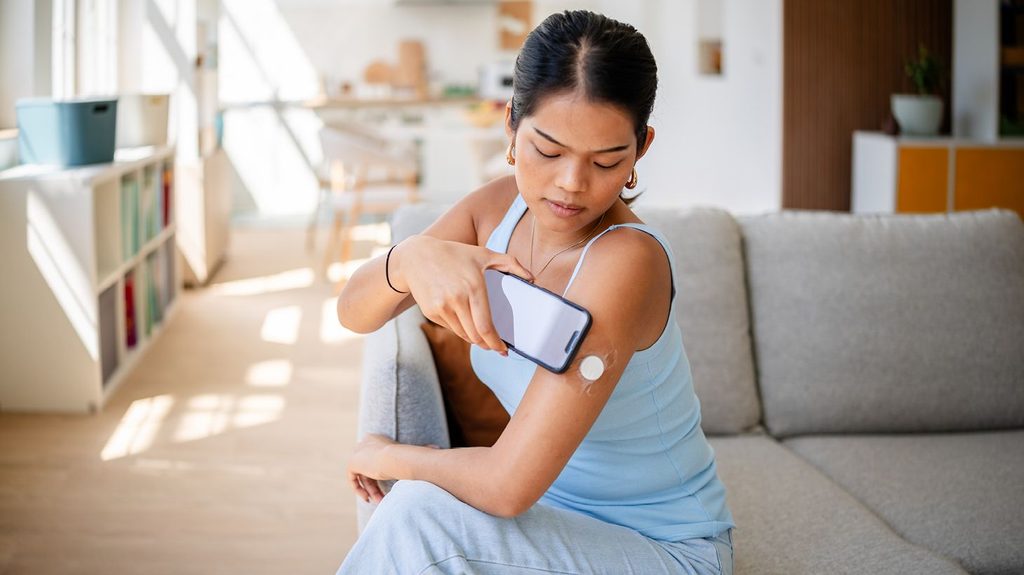
Continuous Glucose Monitors (CGM)
Medicine is increasingly moving toward a personalized model, where prevention and treatment are guided by an individual’s unique biology and lifestyle. Modern advances in wearable technology are accelerating this shift. Continuous glucose monitors are one of the technologies that is changing care. Initially just for diabetes, now CGMs are being used in non-diabetics to inform people of the effects on individual responses to food, exercise, sleep, and stress. These are key components of personalized lifestyle medicine.
How Does a CGM Work?
A small sensor is worn on the back of the arm or abdomen and typically replaced every 10–15 days, depending on the device. Rather than measuring glucose directly from the bloodstream, CGMs measure glucose in the fluid under the skin. Readings are transmitted automatically to a smartphone every few minutes, allowing users to observe not only their current glucose level but also whether glucose is rising, falling, or remaining stable.
Unlike a single laboratory glucose measurement, CGMs provide a continuous picture of glucose behavior throughout the day and night, illustrating how meals, exercise, sleep, stress, illness, and medications influence glucose regulation.
Proven Benefits for People with Diabetes
The clinical value of CGMs is well established in diabetes care. The American Association of Clinical Endocrinology (AACE) recommends CGM use because it helps patients achieve glucose targets, reduces episodes of low sugars (hypoglycemia), improves quality of life, and supports individualized treatment decisions. Continuous feedback also allows patients and clinicians to recognize patterns that would be impossible to identify through occasional finger-stick testing alone. [1]
Can CGMs Be Helpful If You Don’t Have Diabetes?
Studies suggest that glucose responses vary substantially between individuals — even after eating the same meal. Research has also shown that approximately 15% of healthy adults and up to 36% of individuals with prediabetes experience glucose values that transiently reach the diabetic range after meals.
A short-term CGM trial (typically 10–15 days) can reveal these personalized glucose patterns. When combined with a detailed food diary and activity log, many individuals discover that foods they assumed were “healthy”— such as fruit smoothies, granola, or refined whole-grain products- produce much larger glucose excursions than expected, while other foods have minimal impact. [2]
For motivated individuals, this real-time feedback can encourage meaningful changes in dietary choices, meal timing, physical activity, and weight management. In this way, CGMs can serve as valuable behavioral coaching tools rather than simply glucose monitors.
Understanding the Limitations
Because they measure glucose in body fluid rather than directly in the bloodstream, readings typically lag behind blood glucose by several minutes, particularly after meals or during exercise when glucose levels change rapidly.
Accuracy also varies among devices and across different populations. Several studies suggest that CGMs may overestimate glucose responses in healthy individuals compared with capillary finger-stick testing. For this reason, unexpected readings may occur and if needed may warrant a traditional finger-stick measurement for confirmation. [3,4]
Potential downsides of CGM use is that some users experience alarm fatigue, become overly focused on individual glucose fluctuations, or develop unnecessary anxiety from constantly monitoring normal physiologic variation. Cost and the inconvenience of wearing a sensor may also limit long-term use.
Practical Take-Home Points
For most healthy adults, continuous glucose monitoring is not necessary as a routine wellness tool.
However, it can be particularly valuable for individuals who:
- Have prediabetes or metabolic syndrome
- Have a strong family history of diabetes
- Are overweight or have other cardiometabolic risk factors
- Want personalized feedback to optimize nutrition and exercise habits
- Are highly motivated by objective, real-time data
In these situations, a short-term CGM trial, combined with a food and activity journal, often provides enough information to identify meaningful opportunities for lifestyle improvement without requiring continuous long-term monitoring.
Sources:
- Grunberger G, Sherr J, Allende M, et al. American Association of Clinical Endocrinology Clinical Practice Guideline: The Use of Advanced Technology in the Management of Persons With Diabetes Mellitus. Endocrine Practice. 2021;27(6):505-537.
- Dehghani Zahedani A, Shariat Torbaghan S, Rahili S, et al. Improvement in Glucose Regulation Using a Digital Tracker and Continuous Glucose Monitoring in Healthy Adults and Those with Type 2 Diabetes. Diabetes Therapy. 2021;12(7):1871-1886.
- Identifying the Deficiencies of Currently Available Continuous Glucose Monitors to Improve Uptake and Benefit. Diabetic Medicine. 2024.
- Continuous Glucose Monitor Overestimates Glycemia, With the Magnitude of Bias Varying by Postprandial Test and Individual: A Randomized Crossover Trial. The American Journal of Clinical Nutrition. 2025.