



Regular movement is one of the most powerful tools we have to prevent and treat chronic conditions, including high blood pressure, diabetes, heart disease, osteoporosis, and certain cancers.
While aerobic exercise remains important for heart and lung health, new research highlights the equally important role of resistance (strength) training, as well as balance and flexibility exercises. Together, these forms of movement help preserve muscles, improve metabolic health, maintain bone strength, reduce fall risk, and support healthy aging.
Below, we share a simple “movement prescription” that combines aerobic activity, strength training, and balance and flexibility exercises to help you build a well-rounded and sustainable exercise routine. Please feel free to use our visual guide and more detailed instructions that follow, alongside suggestions on how to progress and when to not exercise.
Download the Exercise Guide (PDF)
Aerobic Exercise
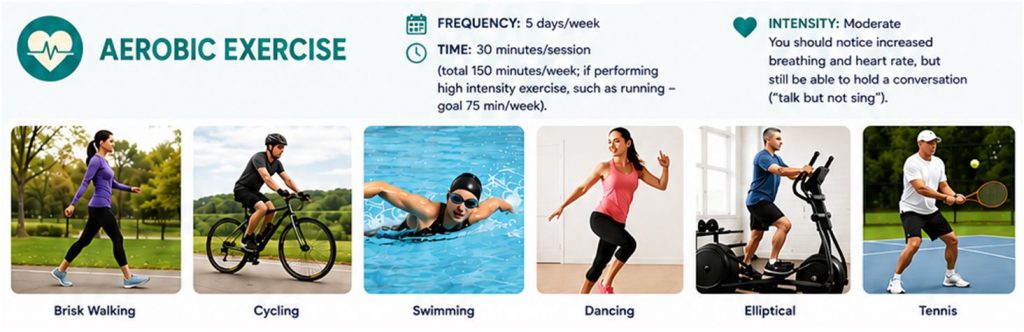
Frequency: 5 days/week
Time: 30 minutes/session (total 150 minutes / week; if performing high intensity exercise, such as running — goal 75 min/week).
Intensity: Moderate — You should notice increased breathing and heart rate but still be able to hold a conversation (“talk but not sing”).
Exercise Type:
- Brisk walking
- Cycling
- Swimming
- Dancing
- Elliptical
- Tennis
Resistance Training
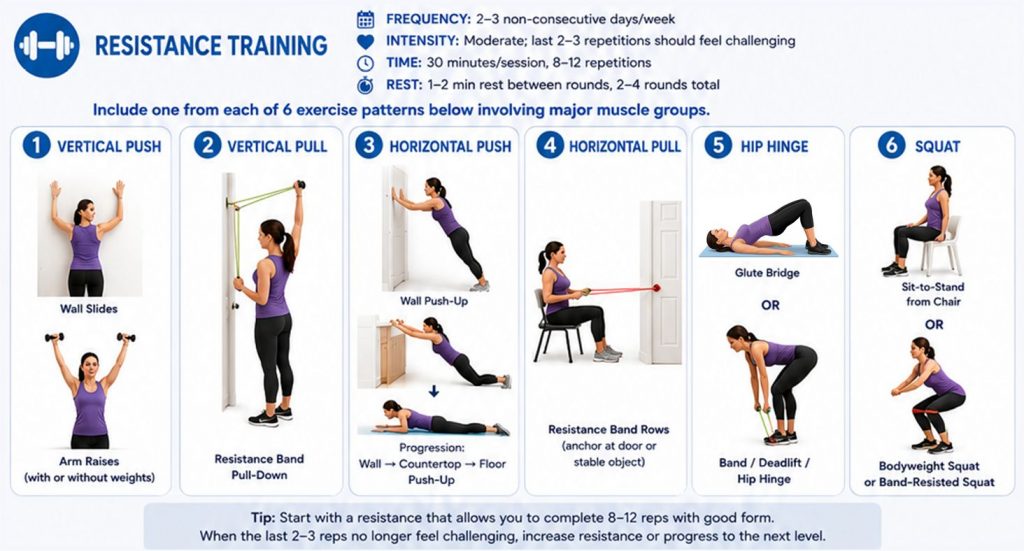
Frequency: 2–3 non-consecutive days/week
Intensity: Moderate; last 2–3 repetitions should feel challenging
Time: 30 minutes/session, 8–12 repetitions, 1–2 min rest between rounds, 2–4 rounds total
Rest: 1–2 min rest between rounds, 2–4 rounds total
Type: Choose one from each of 6 exercise patterns below involving major muscle groups.
1. Vertical push
- Wall slides / seated wall slides
- Arm raises (with or without weights)
2. Vertical pull
- Resistance band pull-down
3. Horizontal push
- Wall push-ups (with increasing the tolerance progress to countertop push-ups and floor push-ups)
4. Horizontal push
- Resistance band rows (anchor at door or stable object)
5. Hip hinge
- Glute bridge (progress to single-leg bridge)
- OR band / deadlift / hip hinge
6. Squat
- Sit-to-stand from chair (progress to bodyweight squat)
- OR band-resisted squat
Balance Training
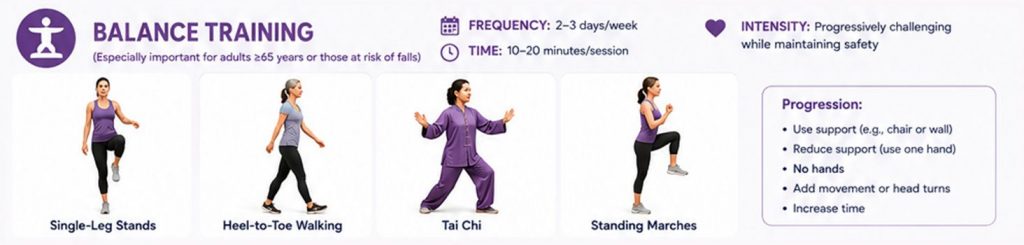
(Especially important for adults ≥65 years or those at risk of falls)
Frequency: 2–3 days / week
Intensity: Progressively challenging while maintaining safety
Time: 10–20 minutes / session
Type:
- Single-leg stands
- Heel-to-toe walking
- Tai Chi
- Standing marches
Flexibility / Mobility
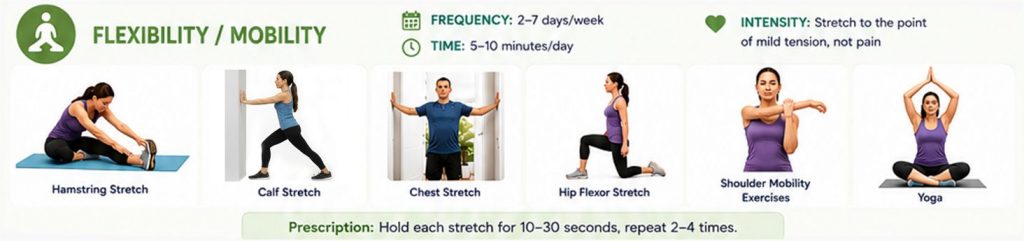
Frequency: 2–7 days / week
Intensity: Stretch to the point of mild tension, not pain
Time: 5–10 minutes / day
Type:
- Hamstring stretch
- Calf stretch
- Chest stretch
- Hip flexor stretch
- Shoulder mobility exercises
- Yoga
Prescription: Hold each stretch for 10–30 seconds, repeat 2–4 times.
Never stretch into pain.
Summary of Your Weekly Exercise Goal
Aerobic (cardio):
- Aim: 150 minutes per week
- Example: 30 minutes, 5 days per week
- Type: brisk walking, cycling, swimming
- Intensity: you should be able to talk but not sing
Strength (resistance training):
- Aim: 2–3 days per week
- Focus: all 6 major muscle groups
- Minimum: 1–3 sets of 8–12 repetitions
- Rest: at least 48 hours between sessions
Daily movement:
- Avoid sitting >30 minutes at a time
- Add extra steps (goal: increase baseline gradually)
- Light activity after meals helps blood sugar
How to Progress
Use 10% rule: increase your exercise time, distance, weight, or repetitions by no more than approximately 10% per week.
For aerobic exercise:
- Increase walking speed or add hills.
For resistance training:
- First, increase number of repetitions by 2 every week (8 → 10 → 12 sets )
- Second, increase number of sets (1 set → 2 sets → 3 sets )
- Third, increase resistance ( heavier resistance band, lower countertop height, deeper squat, higher step)
For balance training:
- Start by holding chair for support and perform single-leg stand for 10 seconds (10s → 20s → 30s → 30 s + turn head one way then another)
- With time, use less hand support, increase hold time
For flexibility training:
- Hold stretches 10–15 seconds initially. Increase hold to 20-30 s→ increase repetitions → add additional stretches.
Remember:
- Start slowly and progress gradually.
- Consistency is more important than intensity.
- Listen to your body and rest when needed.
- Stop and consult your healthcare provider if you experience pain, dizziness, shortness of breath, or chest discomfort.
Special Situations
High blood pressure: All exercise helps; even short sessions lower BP
Diabetes: Light walking after meals improves blood sugar
Weight loss: Exercise helps maintain weight loss; best results when combined with nutrition
Bone health: Resistance and weight-bearing exercise improve strength and reduce fall risk
Safety
Do NOT start vigorous exercise if you have:
- Recent heart attack or unstable chest pain
- Severe shortness of breath at rest
- Uncontrolled heart rhythm
- Severe dizziness or fainting